Daytime sun, evening lights, and six hours of non-stop cricket. That’s the rhythm of a Sunday double-header in the Indian Premier League—and in the business end of May 2026, when every run shifts the playoff picture, it’s also the most fertile ground for betting multis across two matches.
Building a single bet on one game is straightforward. Stretching one stake across two matches—potentially on different pitches, against contrasting attacks, with players in vastly different form—is a sharper skill. This guide walks you through the structure of a winning cross-match multi for the mid-May double-headers, from leg selection to bankroll sizing, using the 2026 season’s clearest trends.
Why Double-Headers Are a Bettor’s Goldmine
The IPL’s Sunday double-headers—one match kicking off at 3.30 PM IST, the second at 7.30 PM IST—create a condensed betting window with unique advantages. The pre-match research for both games can be done in a single sitting. Player availability, injury news, and pitch reports arrive together. Most importantly, the bookmaker’s odds for the evening game are often posted while the afternoon match is still unfolding, meaning lines haven’t yet been fully sharpened by late betting volume.
For the punter building a multi, this means two things. First, you can lock in a price on the second leg before the broader market has fully digested the afternoon result. Second, if you strike an early winner in the 3.30 match, you can either let the multi ride or, in some cases, cash out a partial profit before the evening game begins. It’s flexibility wrapped in opportunity.
The Mid-May Double-Header Slate: Context is Everything
By mid-May, the IPL has reached the point of no return. The league stage ends on 24 May, and the points table has stratified into three groups: the likely qualifiers, the mid-table scrap, and the eliminated. This clarity is a bettor’s friend.
The Rajasthan Royals are hovering around the top four with a young batting lineup that has produced 27 fifties combined—the hallmark of a side where contributions come from multiple sources. Meanwhile, PBKS sit atop the table with 11 points from six matches and a net run rate of +1.420, their death bowling remaining the only serious question mark. These two sides could easily clash in the afternoon window on Sunday, 17 May, with Dharamsala’s altitude and short boundaries setting the stage for a run-fest.
In the evening slot, RCB at the Chinnaswamy—where Virat Kohli is still closing in on 9,000 IPL runs—facing a side like Gujarat Titans could be the perfect second leg. The Chinnaswamy’s 196-run average first-innings total and its 72% hit rate on the “over 34.5 sixes” market make it the most multiplier-friendly venue in the tournament.
Knowing which trends bind each venue and each team is the starting point for building a multi that actually holds together.
Building Cross-Match Multis: The Golden Rules
Not every leg belongs in a multi. Combining unrelated, high-value singles into a single bet is the fast track to disappointment. The three golden rules are simple.
1. Avoid correlated outcomes. If you’re backing a top-order batsman to score over 25 runs and his team to post a big total, the legs are correlated—when one hits, the other usually does too. Cross-match multis are most profitable when they pair legs that are genuinely independent, like a bowler’s wicket total from the first match and a batsman’s run line from the second.
2. Don’t overreach. A three-leg multi at odds of 3.50 that you genuinely believe in is worth far more than a seven-leg miracle at 40.00. Every additional leg increases the bookmaker’s hold and decreases your probability of landing the bet. For a two-match double-header, two or three legs—one from each game, possibly a third “anchor” leg—is the sweet spot.
3. Anchor with a high-confidence prop, chase with value. Your first leg should be something that hits in 65%+ of games based on the season’s data. For May 2026, that means Anshul Kamboj’s over 1.5 wickets (2.10–2.25) or Abhishek Sharma’s over 22.5 runs (1.83). Anchor the multi there, then layer a slightly longer leg from the evening game—like a specific batsman to score a fifty at 2.50.
High-Value Legs for Mid-May Double-Headers
Leg 1: The Anchor Prop (Afternoon Match)
Anshul Kamboj (CSK) has taken 13 wickets in six matches this season, with his over 1.5 wickets bet landing in five of six appearances. His powerplay strike rate of a wicket every 12 balls is the best among Indian pacers. If CSK are playing the afternoon game at Chepauk, where the track grips and Dhoni uses him as an enforcer, this leg is as close to a lock as T20 betting offers.
Alternatively, if SRH are in the 3.30 slot, Abhishek Sharma’s over 22.5 runs line remains one of the most consistent wins of the season, clearing in six of seven innings. The market hasn’t fully adjusted to his 215 strike rate, so the price remains generous.
Leg 2: The Sixes Overlay (Shared Across Matches)
The total match sixes market is one of the few bets that can safely be applied to both games without violating the independence rule. At Chinnaswamy, the “over 34.5 sixes” line has been a profitable play all season, landing in 72% of matches. At Wankhede and Dharamsala, trust the same. At Chepauk, fade it—instead, back the under on sixes and the spinner to take 2+ wickets.
Pairing the afternoon “over sixes” with an evening “over sixes” in a two-leg multi yields a combination price around 3.00–3.30. It’s not glamorous, but it’s built on the season’s most reliable trend.
Leg 3: The Player Narrative (Evening Match)
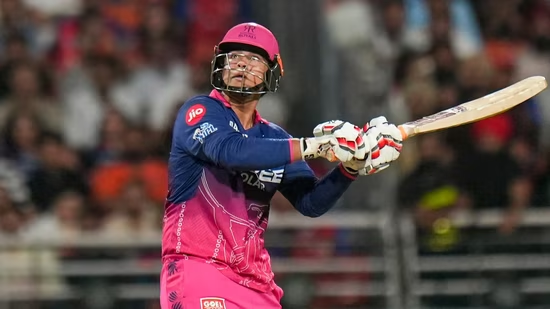
Virat Kohli needs 92 runs for 9,000 IPL runs. His afternoon session in a day game at Chinnaswamy is the perfect setting for a controlled innings. His over 26.5 runs line at 1.85 becomes a compelling final leg to a cross-match multi. Alternatively, if Vaibhav Sooryavanshi (RR) is opening in the afternoon game, his over 18.5 runs at 1.85 has also been a consistent winner, as markets remain slow to price the 15-year-old’s 236-strike-rate explosion.
Leg 4: The Finisher’s Touch (Both Matches)
The death-overs “over 4.5 sixes” market is another repeatable angle. It’s available for both matches and can be used as a single leg across the double-header. Tim David (RCB), Tristan Stubbs (DC), and Abhishek Sharma (SRH) are all death-overs assets, and their teams often push the total past 45 runs in the last five overs. If you’re looking for a leg to push the multi’s odds up from 2.50 to 3.50, this is the one.
Example Multis for a Sunday Double-Header (17 May)
Here are two structured multis for a hypothetical double-header of RR vs PBKS (3:30 PM, Dharamsala) and RCB vs GT (7:30 PM, Chinnaswamy).
Multi 1: The Data-Driven Three-Legger (Odds ~3.50)
| Leg | Match | Bet | Reason |
|---|---|---|---|
| 1 | RR vs PBKS | Abhishek Sharma over 22.5 runs (if SRH, else Sooryavanshi over 18.5) | Consistent prop, high hit rate |
| 2 | RR vs PBKS | Over 34.5 match sixes | Dharamsala altitude, short boundaries |
| 3 | RCB vs GT | Virat Kohli over 26.5 runs | Milestone chase, Chinnaswamy home comfort |
Multi 2: The Risk-Reward Powerplay (Odds ~6.50)
| Leg | Match | Bet | Reason |
|---|---|---|---|
| 1 | RR vs PBKS | Fast bowler to take first wicket (Rabada/Kamboj) | Powerplay pace dominance at true-bounce venues |
| 2 | RCB vs GT | Tim David to hit a six + score over 18.5 runs | Death-overs finisher at a six-hitting paradise |
| 3 | RCB vs GT | Total match runs over 380.5 | Chinnaswamy’s first-innings average of 196, dew effect |
Managing Your Bankroll Across a Double-Header
A two-match day can easily become a betting marathon. Set a daily budget before the first ball of the afternoon game, and divide it into four units: one for the afternoon single bet, one for the evening single, one for the cross-match multi, and one as a reserve. If the multi lands, bank the profit. If it doesn’t, resist the temptation to chase with a larger stake on the final leg. The evening match is an independent event; treat it that way.
Use cash-out wisely. If the afternoon legs of your multi have won and you’re holding a live ticket on the evening match, consider a partial cash-out to lock in profit if the evening game’s conditions—say, unexpected rain or a late injury—alter the risk profile.
Responsible Betting Across a Double-Header
The volume of cricket on a double-header Sunday can trick the brain into thinking more bets are better. They aren’t. Pre-select your two or three best angles, write them down, and don’t deviate. Use deposit limits and time-out tools on your betting platform to keep the day enjoyable rather than stressful. Betting should complement the cricket, not consume it.
The Final Over
Mid-May’s IPL double-headers are the perfect storm for the patient multi-builder. The data has ripened, the player narratives are in full bloom, and the odds still carry a touch of fat that keen-eyed punters can trim. Anchor your multi on the season’s most bankable props, layer a venue-specific totals angle, and close with a player milestone that carries the weight of history.
Two matches, one ticket, and a day of cricket that could be as profitable as it is entertaining. That’s the double-header difference.
Build Your Winning Multis with Sky247 Cricket
Sunday double-headers demand a platform that moves as fast as the game. At Sky247 Cricket, you get instant in-play odds on every ball, Same Game Multis across every IPL match, and the best prices on player props—from Kamboj to Kohli, from Abhishek to Sooryavanshi.
Don’t just watch the double-headers. Bet them with the sharpest multis in the market. Sign up with Sky247 Cricket today, claim your mid-May bonus, and build your cross-match multis with confidence. Play responsibly.